Why Choose a Stepper Electric Motor for Your Next Project?
When considering the best options for precision control in your next project, stepper electric motors emerge as a compelling choice. Renowned expert Dr. Emily Carter, a leading figure in the Stepper Electric industry, states, "Stepper electric motors enhance accuracy and efficiency in countless applications." This assertion highlights the unique attributes of stepper electric motors, such as their ability to offer precise positioning and repeatability.
In various applications—from 3D printers to robotics—stepper electric motors are favored for their reliability. They maintain torque at low speeds, ensuring optimal performance. Yet, some users may overlook their limitations. For instance, while they provide excellent control, they can struggle at high speeds, leading to potential challenges in demanding environments. Understanding these nuances is crucial for successful integration.
Choosing the right stepper electric motor is vital. It requires careful consideration of specific project needs. It's not just about speed; it's about matching the motor characteristics with your application requirements. By weighing these factors, you can harness the full potential of stepper electric motors to drive innovation.
Understanding Stepper Electric Motors: Basics and Benefits
Stepper electric motors offer precision and control, making them ideal for various applications. They are widely used in robotics, 3D printers, CNC machines, and more. According to a recent industry report, the global stepper motor market size is expected to reach $9.5 billion by 2026, growing at a CAGR of 6.2%. This growth reflects a rising demand for automation and compact solutions in various fields.
Understanding the working principles of stepper motors is crucial. They convert electrical pulses into precise mechanical movements. Each pulse corresponds to a specific rotation, providing high accuracy without feedback systems. However, it’s important to consider that stepper motors can exhibit resonance at certain speeds. This can lead to vibration, affecting performance. Therefore, testing in your application is key to ensuring optimal function.
Tips: When selecting a stepper motor, consider torque requirements and power supply compatibility. Choose a driver that matches your motor specifications. Keep in mind that while stepper motors are reliable, they can become inefficient at high speeds. Balancing torque with speed is essential for successful implementation.
Why Choose a Stepper Electric Motor for Your Next Project? - Understanding Stepper Electric Motors: Basics and Benefits
| Feature |
Description |
Benefits |
| Precision Control |
Stepper motors can move in precise increments, allowing for exact positioning. |
Ideal for applications requiring precise movement, such as 3D printers or CNC machines. |
| Open Loop Control |
Stepper motors can operate without feedback systems, simplifying design. |
Reduced complexity and cost compared to closed-loop systems. |
| High Torque at Low Speed |
Stepper motors provide high torque even at low speeds, enhancing performance. |
Suitability for applications requiring strong holding torque, like robotics. |
| Versatile Applications |
Can be used in various applications, from medical devices to automation systems. |
Flexibility in design sets stepper motors apart from other motor types. |
| Robust Construction |
Stepper motors are built to endure extensive use and harsh conditions. |
Improved reliability and long service life for demanding applications. |
Key Advantages of Using Stepper Motors in Various Applications
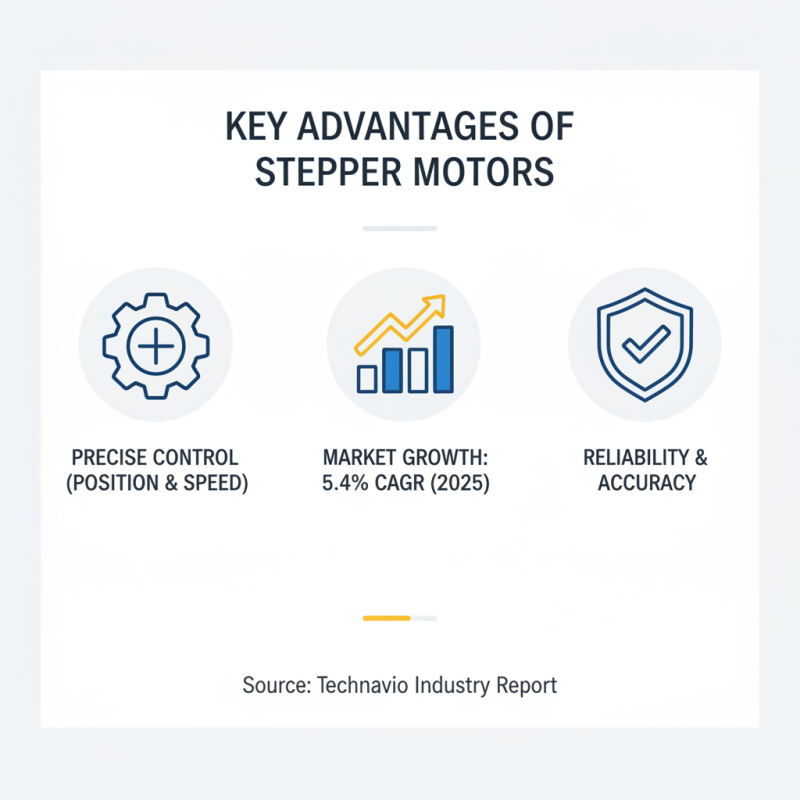
Stepper motors are gaining popularity in various applications due to their unique advantages. One significant advantage is precise control of position and speed. According to a recent industry report by Technavio, the stepper motor market is expected to grow by 5.4% annually through 2025. This growth indicates that many industries are recognizing the importance of accuracy and reliability in motor performance.
Stepper motors excel in applications requiring consistent performance. They provide incremental movement, which is critical for 3D printers and CNC machines. These motors maintain their position without the need for feedback systems. This makes them cost-effective, as they reduce the complexity of designs. In addition, they can handle loads effectively while maintaining accuracy.
Tips: When selecting a stepper motor, consider the torque requirements of your application. Match the motor's specifications to your project's needs. Ensure you have a properly designed driver to avoid overheating. It's essential to monitor performance closely, as improper use can lead to missed steps or inefficiencies.
Another benefit of stepper motors is their adaptability. They can operate in various environmental conditions. From industrial settings to laboratory environments, they perform consistently. However, users should remain vigilant. Temperatures outside the motor's rating could lead to failure. Regular checks can help prevent such issues and maintain optimal performance.
How Stepper Motors Function: The Mechanics Behind Precision Movement
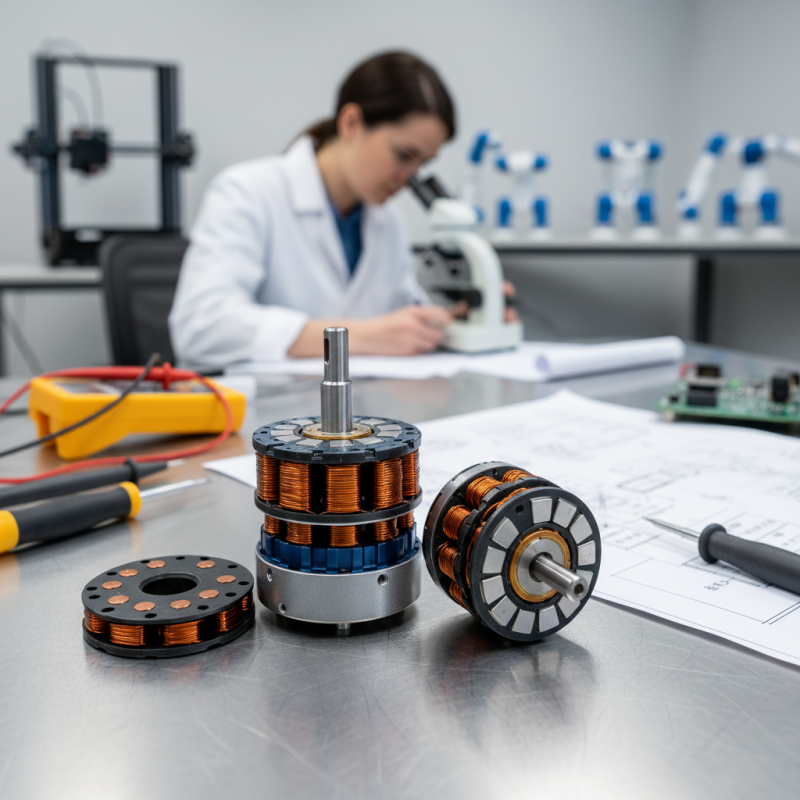
Stepper motors are renowned for their precision and control in various applications. Their unique design allows for precise positioning without the need for encoders. They move in discrete steps, which means that specific commands can yield expected positions. The mechanics behind this are rooted in electromagnetic principles. When current flows through the motor coils, it generates a magnetic field that pulls the rotor into alignment with this field. This interaction creates precise and repeatable movement.
However, using stepper motors is not without challenges. They can lose steps if overloaded or run too fast, leading to inaccuracies. Understanding torque characteristics is critical. The motor's performance varies at different speeds and loads. Likewise, power consumption can soar if the motor is left energized without movement. These nuances require planning and thoughtful implementation in any project.
For applications where precision is essential, stepper motors excel. Their abilities shine in 3D printers, robotics, and CNC machines. But, it's important to analyze the context and requirements of each project. Balancing the motor's capabilities with the demands of the system is crucial.
Comparing Stepper Motors with Other Motor Types: Pros and Cons
When selecting a motor for precision applications, stepper motors stand out due to their unique benefits. According to industry reports, stepper motors are inherently capable of achieving high accuracy in position control, making them suitable for 3D printers and CNC machines. They offer excellent holding torque without requiring feedback systems. However, they can exhibit resonance issues at higher speeds, which may affect performance.
In contrast, DC motors provide a smoother operation over a wider speed range. Yet, they require encoders for precise control, increasing complexity and cost. Servos tend to excel in speed and torque but may lack the simplicity and reliability of stepper systems. A key trade-off lies in the balance between needed precision and programmatic complexity, which should be considered in any design phase.
Tips: Always analyze your project specifications carefully. Understand if you need precise positioning or high-speed operation. It’s crucial to evaluate your project's requirements systematically. Remember, a mismatch in motor type can lead to significant inefficiencies. Reflect on potential issues like noise and overheating, especially with higher step rates in steppers. These factors can derail project timelines and lead to unexpected costs.
Selecting the Right Stepper Motor for Your Project: Considerations to Make
When selecting a stepper motor for your project, several key factors come into play. Consider the required torque and speed. A motor with inadequate torque can lead to underperformance and project failure. Analyze your load requirements carefully to avoid surprises and rethink your choices if the initial specs seem inadequate.
Voltage and current ratings matter as well. Match these ratings with your power supply to ensure optimal performance. An imbalance can impact efficiency, leading to overheating or erratic behavior. Sometimes, developers overlook this when rushing into design.
Tips: Always test different motor specifications before finalizing your selection. Experimentation often reveals insights that initial calculations might miss. Don’t hesitate to reach out to experts in the field for guidance. Their experience can help you refine your approach and clarify doubts. A stepper motor is a powerful tool, but it requires careful consideration to unleash its full potential.